

Data collection & annotation
Building the eyes for embodied AI, one clip at a time
This company is training the next generation of embodied AI and vision-language-action models — systems that need to watch a human do something before they can learn to do it themselves. DesiCrew runs the entire pipeline behind that training data: fielding the collectors, capturing the footage, cutting it down to the moment that matters, and captioning it by hand.
5 min read
This company is training the next generation of embodied AI and vision-language-action models — systems that need to watch a human do something before they can learn to do it themselves. DesiCrew runs the entire pipeline behind that training data: fielding the collectors, capturing the footage, cutting it down to the moment that matters, and captioning it by hand.
A model that learns to act in the physical world only ever knows what it was shown. DesiCrew builds what it's shown — from the moment a collector presses record to the moment a captioned clip lands in the training set — so the model never learns the wrong lesson from a messy one.
01 — The Mandate
The company is building AI that has to understand human action, not just recognize objects in a still frame. That means training data with a body in motion, a task underway, and a first-person view of how it's done. DesiCrew builds that data, end to end.
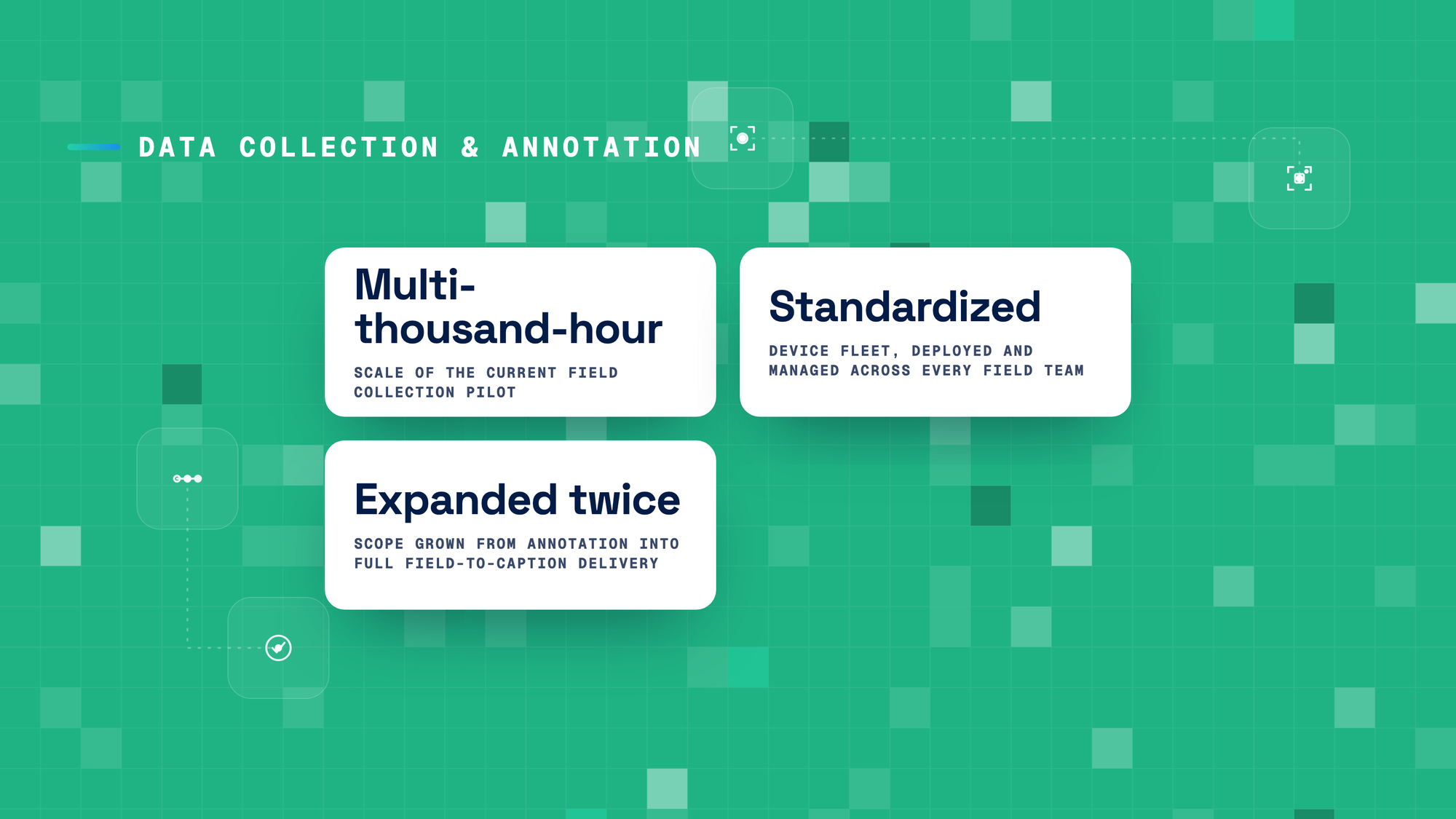
- Scale. A field collection pilot spanning a multi-thousand-hour volume of egocentric video across a major metro region, on top of an existing annotation engagement.
- Full stack. DesiCrew owns every stage — collection, curation and triage, trimming, and captioning — so the client is never assembling training data from four different vendors.
- A standing field operation. A dedicated coordination layer recruits, trains, schedules and supervises collectors on the ground, with a standardized device fleet so footage is consistent regardless of who's holding the camera.
- Grown, not just delivered. What began as a defined annotation scope has expanded twice — first to bring collection in-house alongside annotation, then into a dedicated large-scale field pilot.
02 — The Challenge
Labeling a still image is a solved problem. Capturing and curating footage a model can learn a task from is not. There's no dataset to download for this — someone has to go out, perform the task, film it correctly, and hand it off clean.
- The footage has to exist first. Unlike most annotation work, there is no raw data sitting in a bucket waiting to be labeled — every hour starts with a collector, a device, and a task performed correctly on camera.
- Most of what's shot doesn't survive. Framing, lighting, task completeness, and adherence to the brief all have to hold up before a session is worth annotating at all — footage that doesn't meet the bar gets re-shot or dropped, not patched.
- A clip is only useful if it's precisely bounded. A model trained on footage with dead time, transitions, or the wrong action in frame doesn't learn the task — it learns noise. Every clip has to be trimmed to exactly the sequence that matters.
- The caption has to be exactly right, not approximately right. A VLA model doesn't just need to know a task happened — it needs to know what happened, to what object, with what intent, in language it can train on.
Anatomy of one clip — why a raw recording isn't training data
A single field session doesn't become training data by being filmed — it becomes training data by surviving a series of checkpoints. It's reviewed against acceptance criteria and either passed or sent back. It's trimmed down from a full recording to the exact task sequence a model needs to see. It's captioned — the action, the object, the intent — by a person who watched it happen. Only then does it enter the training set. Skip a checkpoint, and the model doesn't fail loudly; it just quietly learns the wrong thing.
03 — The Approach
DesiCrew built a repeatable, quality-gated pipeline for this engagement and scaled it as the program grew.
- Collect in the field. Collectors capture egocentric and exocentric video of real task execution on a standardized device fleet, coordinated by a dedicated field team handling recruitment, scheduling, site access and day-to-day supervision.
- Curate and triage before anything moves downstream. Every session is checked against defined acceptance criteria — framing, lighting, task completeness, brief adherence — before it enters production, so annotation effort is never wasted on unusable footage.
- Trim to the task. Accepted footage is segmented and cut down to the specific action sequence a model needs, stripping out dead time and irrelevant content.
- Caption by hand. Trained annotators describe the action, object and intent in each clip in the structured form VLA training requires, with an internal QC pass before delivery.
- Track delivery like a commercial contract, not a favor. A dedicated operations workbook reconciles hours collected against hours accepted and delivered, giving both sides a live, auditable view of progress.
04 — The Outcome
- A pipeline that scales with the model roadmap. From a defined annotation scope to a multi-thousand-hour field collection pilot, without changing the operating model in between.
- A field operation that's now a repeatable asset. The standardized, distributed collection model built for this metro pilot is built to be redeployed in the next city and the next program.
- A partner trusted with more, not just more of the same. The relationship has expanded scope twice since inception — annotation, to collection-and-annotation, to a dedicated field pilot — each expansion a decision to hand DesiCrew more of the pipeline, not just more volume.
05 — Why the relationship holds
The engagement didn't start as a full-stack partnership — it became one. It began as an annotation scope. It grew into collection and annotation together. It's now a dedicated, multi-thousand-hour field pilot with DesiCrew running recruitment, capture, curation, trimming and captioning as one accountable operation.
- That's the pattern that matters more than any single figure: a client that keeps handing over the next stage of the pipeline, because the last one held up.
About DesiCrew
DesiCrew is an applied-intelligence company — the human and technology layer that makes AI systems and enterprise operations work reliably and grow at scale, refined in production since 2007.


Let's put intelligence to work.
If your AI keeps breaking when it leaves the lab, or your operations are carrying weight AI should be taking off — let's build together.