

Video-KYC fraud review
A fintech onboards a customer in seconds. The only thing between a real face and a forgery is a person who can tell them apart.
The client's video-KYC runs inside the fintech apps millions use to open an account. When its automation can't clear a check on its own, DesiCrew's reviewers decide by hand whether a face is genuine, a deepfake, or a photo of a photo.
5 min read
The client's video-KYC runs inside the fintech apps millions use to open an account. When its automation can't clear a check on its own, DesiCrew's reviewers decide by hand whether a face is genuine, a deepfake, or a photo of a photo.
Automation and a confidence score get the process most of the way. But whether two selfies are one live person or the same uploaded photo, and whether a flawless-looking face is actually a deepfake, is a judgment call. A person makes it on every case the system can't clear itself. So a real customer gets through in seconds, and a fraudster never reaches the financial rails.
01 — The Mandate
This fintech builds the video-KYC that verifies identity inside apps across India and Southeast Asia. Every case its automation can't clear on its own comes to DesiCrew to review by hand.
- Coverage. Reviews run across three markets — India, Vietnam and the Philippines — and across multiple document types: national IDs, driving licences, PAN and health cards, each with its own front-and-back rules by country.
- Two lines of work. Fraud-and-liveness review — catching deepfakes, morphs, injected images and forgeries — and document verification, checking that what was extracted from an ID actually matches the ID.
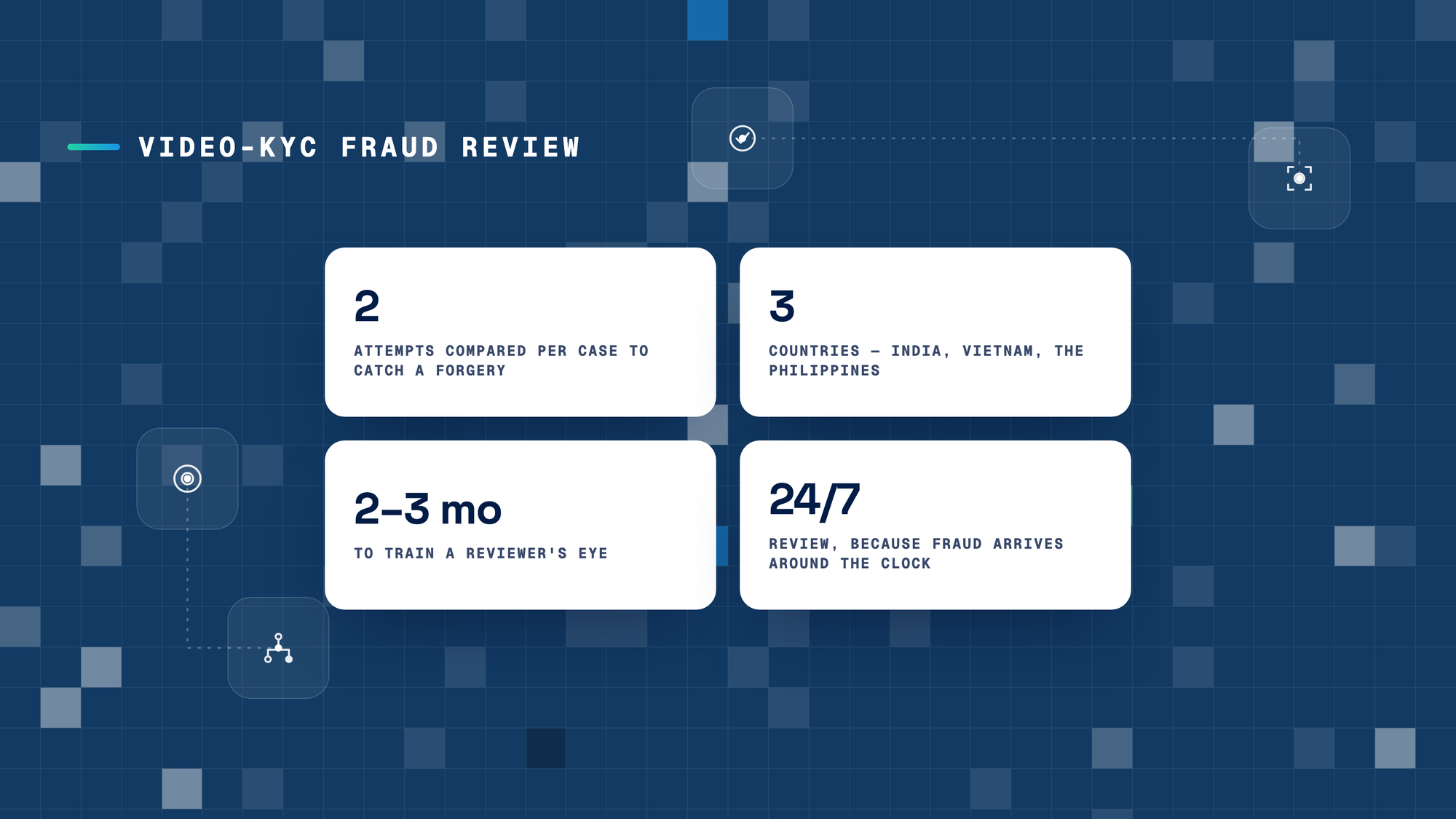
- Always on. The review runs around the clock, because the fraud attempts arrive around the clock too.
- Manual by design. Every case that reaches DesiCrew is one the automation could not clear by itself — so a trained person makes the final call.
02 — The Challenge
The fake that passes is the one that looks perfect. A blocked face or a blurry frame is easy to flag. The hard fraud is the opposite — two images so alike there is no difference between them at all. A real selfie always varies slightly from one attempt to the next; when two attempts match exactly, someone uploaded a photo instead of showing their face. Catching that, and catching a clean-looking deepfake, is why this work can't be left to a score.
- No difference is the tell. When a person takes two selfies, the frames never match perfectly. If they do, it isn't a live face — it's a forgery. The reviewer's job is to notice the absence of natural variation, then mark it fraud rather than genuine.
- A deepfake hides in the detail. A synthetic face can look identical to a real one; the giveaway is often a faint blur or artefact that a trained eye catches and a glance misses. Reviewers are trained for two to three months before they can call it reliably.
- The score is a claim, not proof. OCR extracts an ID's fields — name, date of birth, ID number — and attaches a confidence score; a clean scan might read 90, and blur or glare should pull it to 70. The reviewer validates whether that score matches what is actually on the image.
- The stakes sit downstream. Once a fraudster clears KYC, they are on the financial network and hard to stop. That is why a single missed case matters far more than the volume alone would suggest.
03 — The Approach
DesiCrew reviews what automation can't clear, checks every field against the actual image, and records exactly why each case passed or failed.
- Two-attempt fraud review. Each case is reviewed across two image attempts. The first pass flags the obvious — face blocked, head turned, multiple faces, eye closure, blur. What survives it is checked for the subtler fraud: identical frames, morphs, and injected or deepfake images.
- Field-by-field verification. OCR-extracted fields are checked against the document itself for accuracy, alongside ID quality — blur, glare, capture-from-screen, partial or obscured — with the confidence score corrected where the image doesn't support it.
- Face match and liveness. Selfies are compared face-to-face using face mesh, live against non-live, including against childhood photos where required, to confirm it is the same person — and a live one.
- Standardized comments. Every decision carries a reason — non-live image, video not present, blurry, background not clear — so nothing is a bare pass or fail and the client can see why it landed where it did.
04 — The Outcome
- Real users clear fast. Genuine cases are confirmed and passed through, so a real customer isn't held up by the very fraud check built to protect them — onboarding stays quick for the people who should get in.
- Forgeries stop at the door. Deepfakes, morphs, uploaded photos and injected images are caught before verification completes — before a fraudster ever reaches the financial rails, where the fraud is cheapest to stop.
- Every call is documented. Each case carries a recorded reason and a validated quality score, so the client can show not just that a check ran, but why it landed where it did.
05 — Why the relationship holds
The client runs one of the largest volumes of eKYC in the market, and video-KYC is its core product — the check embedded in the fintech apps people use every day. This is the layer of it that a machine can't sign off alone.
The work rests on human judgment that takes months to build: a reviewer needs two to three months of training before they can reliably tell a genuine face from a deepfake. That trained eye is what the automation can't replace. And because it runs around the clock across three countries and many document types, the review has to hold to the same standard everywhere at once — which is exactly the discipline DesiCrew is built for.
About DesiCrew
DesiCrew is an applied-intelligence company — the human and technology layer that makes AI systems and enterprise operations work reliably and grow at scale, refined in production since 2007.


Let's put intelligence to work.
If your AI keeps breaking when it leaves the lab, or your operations are carrying weight AI should be taking off — let's build together.