




Skip to content

The data your robot needs
doesn't exist yet.

Somebody has to go out and record it. We do that: egocentric and sensor capture, built for diversity, consent-managed from the first frame, then annotated at the volume your training run actually needs.

This data can't be scraped.
It has to be captured.

Language models had it easy. The world had already written itself down, and somebody scraped it.

Physical AI gets no such gift. Every hour of manipulation footage, every egocentric sequence, every sensor frame your robot learns from had to be recorded on purpose, by a person, in a real place, under conditions you will still have to account for four years from now.

Most physical-AI programs stall right here.

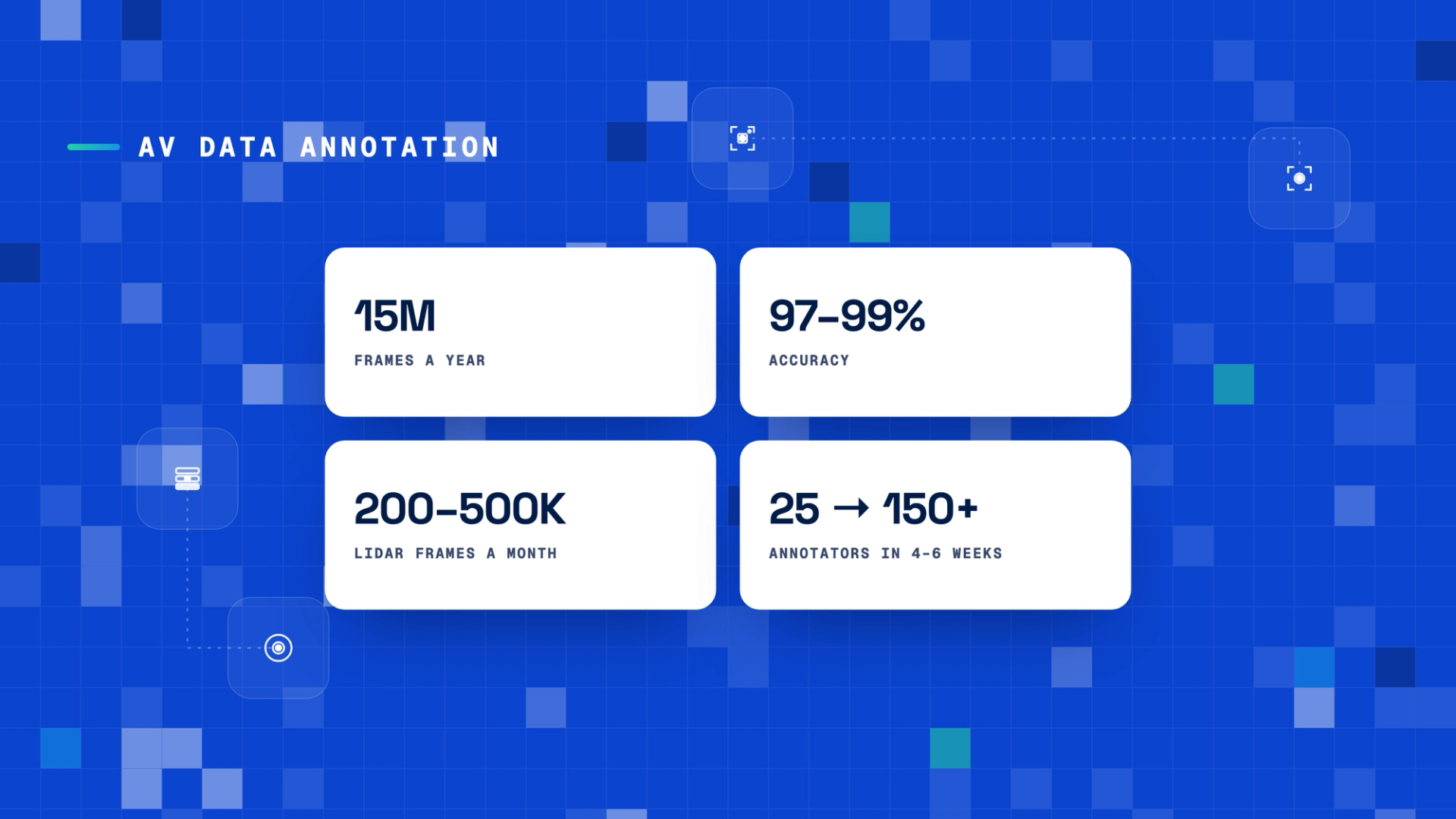
200K–500K

LiDAR frames a month

130K

LiDAR annotations a day

15M+

Frames annotated a year

20M+

Images annotated

97–99%

Accuracy standards

100%

Consent-managed & compliant

L1 · L2 · L3

QA on every pipeline

~2,000

Operations base across India, the USA and Kenya

You only get to capture it once.

Bad labels can be fixed. A shoot you never did cannot. If the lighting, the demographics, the environments and the awkward edge cases weren't in front of the camera, no amount of annotation will put them into your model.

The distribution you capture is the distribution your model believes

A robot that has only ever seen a kitchen at noon will struggle at seven in the evening. Demographic, environmental and edge-case coverage gets specified before anyone starts recording, because you cannot retrofit a gap.

Capture runs on protocol

Somebody stands in a warehouse with a head-mounted rig and performs the same task four hundred times. Getting that consistent takes written instructions, trained contributors, and a reviewer who kills a bad take on the spot, while it can still be redone.

Sensor alignment inherits forward

Calibration and timestamp sync get checked before annotation begins. A rig that drifted by two frames produces beautifully labelled data that teaches your model something untrue.

Consent has a long tail

A face recorded this month has to stay accountable for as long as the dataset lives. We keep the record, keep it revocable, and keep it mapped to the exact frames it covers.

High standards, made checkable.

Anyone can put an accuracy figure on a website. What a training lead actually wants to know is whether it still holds on batch four hundred, six months in, after three people on the team have changed.

Guidelines built with you, first

Class definitions, occlusion rules and the awkward edge cases get argued out before labelling starts, while changing them is still cheap.

L1 · L2 · L3 review

Three levels on every pipeline, with domain-trained reviewers at each.

Golden sets as standard

Your benchmark runs the whole way through the engagement, so drift shows up in week three and not at delivery.

Adjudication on the record

Ambiguous frames go to a named decider. The ruling goes back into the guideline, so the same argument only happens once.

Measured per sensor, per task

2D boxes, 3D cuboids, keypoints and segmentation each get scored on their own instrument. One blended number would hide the class that's slipping.

97–99%accuracy standards
130KLiDAR annotations a day
20M+images annotated

Where the data comes from, and who it came from.

Physical-AI data comes from real people in real places. Somebody agreed to be recorded, and somebody has to be able to prove it years later. We treat that as part of delivery.

Consent, captured and kept

Every contributor consents, the record is retained and auditable, and it stays revocable.

Demographic controls

Age, gender, region, build and environment balanced to the spec, so the dataset doesn't quietly hand back the bias you hired us to remove.

Our teams do the work

Contributors and annotators are on our payroll and trained on your protocol. When one program scaled fast, we took 800 trained professionals live in two days.

Certified and reviewed

ISO 42001 for AI management, ISO 27001 for information security, ISO 9001:2015 for quality. Research partners: CeRAI at IIT Madras, and IIT Mandi.

ISO 42001
ISO 27001
CeRAI, IIT Madras
IIT Mandi

From the shoot floor to model-ready.

Egocentric and exocentric video collection

Head-mounted and fixed-rig capture of people doing real tasks, run to a written protocol with diversity controls set before the first shoot.

Sensor and multimodal capture

LiDAR, camera, audio and multimodal recording, calibrated and time-synced, in the environments where the data you need has never been collected.

Annotation and labelling at sensor scale

Frame-level annotation, 3D cuboids, keypoints, hand-manipulation and VLA labelling, across robotics, embodied agents, human demonstrations, simulation data and multimodal capture.

Scaling a program on demand

Teams trained against your spec and taken live in days, then held at that standard for as long as the program runs.

Built for programs that have to work outside the lab.

Robotics and manipulation

Human demonstration data, grasp and hand-pose annotation, task-level segmentation.

Autonomous vehicles and ADAS

LiDAR, perception and edge-case labelling at production volume.

Smart manufacturing

Defect, process and workspace data captured on working floors.

Consumer and home AI

Egocentric and in-home capture with consent and demographic controls built in.

Send us a capture spec.

Tell us the environment, the sensor stack and the coverage you need. We'll come back with a capture protocol and a scoped pilot. You'll hear back within two business days.